Showing posts with label Food. Show all posts

Tuesday, November 23, 2010

"The Story of Sushi" - Trevor Corson


The Story of Sushi: An Unlikely Saga of Raw Fish and Rice

Tell you what: I don’t know when I’ll be eating sushi again. No, I didn’t learn anything disgusting about it while reading Trevor Corson’s “The Story of Sushi” – except maybe the correct way to prepare an octopus, which seemed unnecessarily cruel. It’s more like I learned everything I wanted to know about sushi (and then some) and now feel no need for it. This book must be what they call “definitive” because I certainly have trouble imagining why I would read about sushi ever again. In a roundabout way, this is actually a compliment.

“The Story of Sushi” not only delves extensively on the historical birth and evolution of what we came to know as sushi, it also follows a sushi chef class in a Californian school/sushi bar. Additionally, it also tells the tale of how this Japanese dish conquered America and the rest of the Western World.

In the last five years sushi bars have made the step from ubiquitous to ridiculous – there is nary a place where sushi is unavailable and mind you I’m not in New York or anything and I’m in walking distance of at least four sushi restaurants. It is so readily available it is almost impossible to believe that not that many years ago it was kind of weird to eat raw fish.

By focusing on a young girl attending the sushi academy, Corson, cleverly chooses a character most of us can empathize with: someone with no ties to Asian culture, someone who didn't grow up in this tradition (or in any cooking tradition, for that matter), she could be any one of us, someone who likes sushi because it tastes fresh and clean yet feels exotic, but has no idea of the difficult preparation process of those cute nigiri or rolls. Alongside Kate we witness how frustrating it is to master so many techniques and information in so little time (traditional sushi apprenticeship went on for years, before students could do more than prepare the rice).

Because Corson is interested in marine biology, there is also a lot of information on the different fish that were traditionally used in sushi and how their popularity has changed over time. It will probably not be surprising to find out that fish (such as salmon) and rolls favored in America are not that popular in Japan.

More surprising to the reader will be the fact that sushi bar culture in Japan, has always been, and to some degree still is, a guy thing. Single women were not welcomed in these establishments and female sushi chefs unheard of. Men come in, sit at the bar, drink sake and eat some nigiri. How ironic is it that sushi bars are now one of the preferred spots for city girls to grab a bite?

If there is something about sushi that has your curiosity piqued then the answer will be here. Corson even provides the reader with a sushi etiquette-guide-to-not-looking-like-a-total-redneck-at-the-sushi-bar (my words, not the author’s). While it is very interesting I think sushi bars will definitely be different in America and Europe than what they are in Japan (for one, women are welcome) and that their continuing popularity will definitely be tied with how comfortable people feel there. While Japan is a nation where ritual plays an important part even in seemingly innocuous tasks, westerners privilege feeling at ease even while striving to be original.

It will be interesting to see what happens to sushi in the next twenty, thirty years. Already, most sushi chefs aren’t Japanese, and most restaurant owners know little about its history except that sushi is it, right now. Will it go the way of Chinese food or follow some original path (maybe everyone will start doing rolls at home)? In either case “The Story of Sushi” is the definitive book on this not-so-exotic-anymore treat for the foreseeable future.

"The Fortune Cookie Chronicles" - Jennifer 8. Lee


The Fortune Cookie Chronicles: Adventures in the World of Chinese Food

For non-American readers the revelations in “The Fortune Cookie Chronicles” will probably come as less of a shock, since, for most Europeans (the uber-sophisticaded world travellers excluded) the first image of Chinese food (and more recently sushi) probably came from watching a random American TV show or movie.

As I followed Jennifer 8. Lee’s delicious chronicles I wasn’t particularly astounded to find out that, in China, fortune cookies (which by the way, are very uncommon in Europe) are not known, and that the most popular Chinese food dishes in America, such as General Tso’s Chicken, Beef and Broccoli and Chow Mein, were creations of Chinese chefs specifically engineered to suit the American palate, favorite ingredients and presentation.

I was surprised however, to find out that fried ice-cream – one of the most popular Chinese desserts in Portugal – was only found by the author in Italy. In fact, as Lee explains, traditional Chinese gastronomy is not known for its sweets. But the Chinese, brilliant at meeting the culinary expectations of different cultures, must have soon found out that, especially in southern Europe, dessert is almost mandatory!

Growing up, I always heard that food in China had almost no similarities with what I ate in Chinese restaurants (something I only started doing quite late, since my family wasn’t big on restaurants or ethnic food – unless you count my mom’s homemade lasagna or pizza), but it’s still fascinating to follow Lee’s explorations in search of the roots of the “Chinese” in Chinese-American food.

But “The Fortune Cookie Chronicles” also offers interesting sociological stories courtesy of Chinese food, such as the age-old relationship between American Jews and Chinese restaurants, the emergence of the first home-delivery systems, and the sad plight of contemporary Chinese immigrants. Impossible not be shocked at the amount most Chinese pay (upwards 50.000 thousand dollars) in order to endure months, sometimes years, of grueling travel so they can be afforded the privilege of ringing our western doorbells and hand us our sweet-and-sour pork.

So, where did the fortune cookie originate? Well, you can find out that fun fact by popping over to Wikipedia right now. But Lee’s book gives the reader a lot more to ponder: even in small western capitals such as Lisbon, eating the ethnic food du jour (nowadays, mostly sushi, to the point that Chinese restaurants seem to have disappeared or recast as nippon counterparts) is the mark of a certain urbanite hipsterism - it signals sophistication and a sense of adventure. Like our cheap t-shirts, however, there is always a hidden cost, and finally what we end up eating is not as original as we might like to think – “The Fortune Cookie Chronicles” will provide any reader with food for thought.

Friday, April 23, 2010

"Serve the People" - Jen Lin-Liu


I just didn’t hit it off with this book. While I was reading “Serve the People: A Stir-Fried Journey Through China”, especially as I reached the middle of the book, I kept asking myself why.

It certainly revolves around themes close to my heart: food and travel; It was on my wishlist for months; I was so excited when it arrived in the mail – and that’s about the most excitement this book caused. And it doesn’t help to know I’m in the minority here. A quick browse through amazon’s customer reviews proves that most found it not only engaging but even "unputdownable".

Maybe a humble “it’s not you, it’s me” would be in order here, but I just can’t quite bring my reader self to that level of self-doubt. A literary critic I am not, but I know a bland book when I read it.

Sad as it may seem to say it (or even cruel) “Serve the People: A Stir-Fried Journey through China” is one of those books that I could have never read and would have made no difference to me whatsoever.

Jen Lin-Liu is the daughter of Chinese immigrants who grew up in San Diego, maintaining few cultural connections with her parent’s homeland. She decided to relocate to China and style herself as a food writer/journalist in 2000. Based first in Shanghai, the book opens as she moves to Beijing which, she explains, has a more “genuine” Chinese feel to it, where she begins taking cooking lessons.

Her colleagues are hardly foodies – mostly men who need a certificate in order to work as cooks – and the teachers have little patience for questions, deviations from standard recipes or even for allowing students to do actual cooking. The author befriends a different teacher at the school, and soon the two become friends, with the middle aged woman telling the author about life under Mao.

However, Chairman Wang’s “revelations” seemed vague and, to me, felt impersonal. I surely did not learn anything I didn’t know already about the Chinese communist regime, and it didn’t really bring the teacher to life either. As for Beijing it sounds grey, cold, chaotic, polluted, a city where the historic quarters were being bulldozed just in time for the 2008 Olympics.

Next up the author starts as an “intern” at a noodle stall – I honestly felt that she had somewhat arm-wrestled herself into the position (by her own admission no established restaurant offered her a job), taking advantage of a kind cook. Lin-Liu speaks of being an “apprentice” noodle maker and that she felt “guilty” showing up for work in a taxi when not even the stall owner could afford such a luxury. She never makes it clear whether she was being payed for her time at the stall. I hope not – Zhang, the cook, was just scraping by, sending most of his money home to his family in the province.

Then there is a chapter where she “interns” at a Shanghai restaurant, where a Malaysian born chef is attempting to follow in the footsteps of western style celebrity chefs. Once again she is not taken on for her cooking skills – she “infiltrates” the kitchen as a journalist. Here cooking is a means to building a business empire – the young chef is clearly, unabashedly, ambitious in a cut-throat manner.

The last pages serve up the author’s blooming relationship with an American expatriate – which felt out of place to say the very least – and the book ends with her decision to open a cooking school.

All in all there seems to be little passion for cooking in the characters the author meets: some are cooks because that was the profession the Maoist regime assigned them, some because it’s a living, others a means to achieve fortune.

A lot of the food didn’t really sound appetizing to me, but I’ve read food-themed books before that I enjoyed even if I wouldn’t eat any of the dishes described.

Sometimes Lin-Liu seems to pull out the shock-value card: but somehow, and I could hardly believe it, she managed to keep me unmoved even as she ate dog-stew and various animal’s penis and testicles. She describes eating fish head at least twice – as if she couldn’t believe it herself – seemingly ignoring that fish head is a common enough dish in many parts of the world.

Then there is the glaring mistake, when she states that the “Portuguese egg tart” is a Chinese dish (so why did she think it’s called “Portuguese”? Fact Check anyone?). Even though Lin-Liu offers precious little historic or cultural culinary facts during the book, this one obvious mistake made me doubt the rest.

“Serve the People” felt stilted and shallow, like one of those short-story collections from Creative Writing program graduates, where every bit of quirkiness feels calculated. I felt the author was unable to put across the magic and wonder of becoming immersed in a different culture – her encounters with Chinese people felt artificial, lacking in empathy and her visual descriptions of cities and landscape didn’t really come alive on the page. It just felt foggy, as if you never really get to the meat of anything, not food, not people, not China and definitely not the author.

Also, the chapters felt disconnected like a bunch of magazine articles thinly put together. And while I hardly wish to seem mean-spirited, if I mention that the author wrote for Time-Out Beijing, you'll probably get a better sense of the kind of urbanite, disconnected, flighty and somewhat entitled tone I'm hinting at.

I almost feel guilty being so critical, but while I didn’t hate this book (it failed to elicit that kind of strong reaction) I certainly would not recommend it.

Monday, June 08, 2009

Yummy Wishlist

Reading memoirs and chronicles that center around food is something I love, but haven't really done lately. Last books I read on the subject were "Climbing the Mango Tree" by Madhur Jaffrey and Elizabeth David's "My Life in France". I much preferred the first - I like my books, if not my food, on the exotic side.

Then I read the second part of Ruth Reichl's autobiography: "Comfort me with apples" which honestly wasn't that good, especially compared with her first "Tender at the Bone", and sort of let the food thing slide for a while.

But no more! I found these three books which I feel certain will provide hours of food craving:

Staling Buddha's Dinner: A Memoir - Bich Minh Nguyen


Bento Box in the Heartland - My Japanese Girlhood in Whitebread America - Linda Furiya


Serve the People: A Stir-fried Journey through China - Jen Lin-Liu


Although, in the spirit of thrift I should probably get to these two - which I got on may last food book binge and still haven't read:

The Passionate Epicure - Marcel Rouff


Endless Feasts: sixty years of writing from Gourmet


My absolute favourites in this collection, you ask? Why, here they are:

Clémentine in the Kitchen - Samuel Chamberlain


Katish - Our Russian Cook - Wanda Frolov

Tuesday, March 03, 2009

Pancake * Hamburger


Hamburger - Andrew F. Smith
Pancake - Ken Albala

Listen very carefully, even though I’ll probably say it again when I review the upcoming “Hot Dog” and “Pie”: you cannot call yourself a foodie if you are not reading the Edible Series.

Look, I’m not saying I’ll get them all – obsessive collecting is not my thing and I can’t imagine myself reading a book titled “Caviar” (probably all the more reason to read it), but you definitely have to get your favorites, because you will have a lot of fun reading them.

These little books are insightful, full of research both scholarly and anecdotal and absolutely brimming with color photos and illustrations. More and more I love a publisher who isn’t stingy with the visuals, and these puppies take the prize. They are also perfect for a weekend read: you read a little Saturday after a late breakfast, a little in the afternoon to help digest lunch and pave way for dinner, and if you really pace yourself you might have a few pages left for a lazy Sunday afternoon.

I love reading about a food but for some reason don’t really like reading recipes (must be that imperative tone), and that’s the only reason “Pancake” is the volume I liked less – a little to many ancient recipes – but I get the author’s point. “Hamburger” I loved, with all that McDonalds drama how could I not? Anyway, for those who do love recipes rest assured each volume has a little appendix.

Reaktion Books’ site doesn’t have the whole collection, so here it is as it appears in the books:
Pancake
Pizza
Hamburger
Spices
Pie
Beer
Cake
Caviar
Chocolate
Cocktails
Curry
Fish and Chips
Hot Dog
Lobster
Tea
Tomato

Thursday, February 19, 2009

A Slice of Heaven and A Dip in Paradise


"Getting Wet- Adventures in the Japanese Bath" - Eric Talmadge
"Pizza - A Global History" - Carol Helstolsky

National identity is a strange, elusive subject, best left to boring, long incomprehensible philosophical treaties (the exception being Norbert Elias “The Germans” which is still a heck of a long book). National obsessions however, are more my speed. Anecdotes abound, history is breezy, meaning can be found just about anywhere, be it in a pizza or a bathtub.

“Getting Wet – Adventures in the Japanese Bath” could probably be shorter, but the black and white photographs and illustrations sort of make up for excessive length. The Japanese are crazy about their bath: boiling hot, communal and filled with yummy minerals is the ticket. This particular obsession has nothing to do with hygiene (you thoroughly wash before getting in the tub, whether at the public baths or at home) and everything to do with relaxation and health (and probably a little to do with pain, since a lot of baths are scalding).

As Eric Talmadge expertly guides the reader through the many facets and rituals connected with Japanese bathing, we learn about the antiquity of this custom (a must for any self respecting national obsession), the etiquette of bathing, and its more recent metamorphoses (in ancient Japan themed baths in Tokyo, for example). Japanese culture being what it is (a mixture of extreme politeness and equally extreme perversity) even sex got into the bath-related craziness in the form of brothels named Soapland (the former name Turkish Bath created a diplomatic incident, when Turkish Girls became synonymous with prostitutes, and tourists started calling the embassy to arrange appointments), where clients pay officially not for sex but for a bath.

Of course sometimes a bath isn’t just a bath. For the Japanese it’s about the whole experience which, done well, involves a beautiful natural environment, a very nice meal and a very comfortable night’s sleep. As often happens with pillars of identity, the younger generation doesn’t seem too interested in keeping up with tradition. The biggest Japanese consumers, (single girls 20-30) are not courted by the (dying) industry and the tattooed are barred from entering (a measure first in stored to keep Yakuza gangsters out of the baths).

Tourism isn’t much of a draw either because everything in Japan is so expensive. Now, if you really want your national obsession to conquer the world you need something cheap, adaptable and…edible – like pizza.

Pizza is the complete opposite of the Japanese baths – it’s a national obsession that successfully turned global, and is capable of adapting so seamlessly into so many corners of the world, that it begs the question – is pizza still Italian?

In “Pizza – A Global History” Carol Helstolsky sort of proves it isn’t. The pizza we mostly enjoy today (take-out pizza, or pizza with lots of toppings, some very exotic) bears little resemblance to the original pizza that the XVIII century Naples lazaroni (beggars and poor men generally) bought on the street to fool hunger – an unleavened bread with a little olive oil, mozzarella cheese and some tomato. Pizza, of course is an ancient dish, so much so that several Mediterranean populations ate variations of thin bread covered with whatever else was available regionally and seasonally.

In that sense, it can be argued that pizza wasn’t specifically Italian to start with (Italy itself being a fairly recent construction) and in that sense very well equipped to become the most popular fast foods ever. It even started out as a fast-food – something to be consumed in the street, while walking.

Helstolsky follows the path of pizza from Naples to the east coast of the USA, to the Midwest where two different sets of brothers founded Pizza Hut and Domino, companies that would alter the dish forever. Softer crusts, more cheese, pineapple and barbecue chicken – you name it, if there was a craving for it you could translate into pizza. If there is a dish that can adequately satiate young and old, carnivore and vegetarian, pizza is it.

While Italy is fiercely protecting the “real” pizza, the author, introduces us to a polish pizza-hut favourite (Indian toppings), gourmet concoctions with truffles and the like, and even regional variations such as “Japanese pizza”, (now if only I could have one after indulging in scalding bath).

“Pizza – A Global History” is from the Edible Series of Reaktion Books – they are small, hardcover books filled with colour photographs, and everyone who likes food will probably want to collect them. “Getting Wet” I got from a sale bin – at 2 euros it was quite the bargain even if the dustcover is torn –in that sense it is great value for money, otherwise it’s more of a gift for Japan enthusiasts.

Tuesday, December 23, 2008

Julian Barnes - Flaubert's Parrot and The Pedant in the Kitchen


Since “An Expert in Murder” is turning out to be a disappointment I stopped reading it and picked up Julian Barnes’ “Flaubert’s Parrot” (1984) and liked it so much I immediately started “The Pedant in the Kitchen” (2003) which I just finished.

“Parrot” and “pedant” are two very different books – the first a novel that, until about half way through reads like pure non-fiction, and the second a collection of columns on food, cooking, recipe books etc.

“Parrot” delves into the life of Flaubert in various ways as our protagonist attempts to solve a biographical puzzle: which one of two surviving stuffed Amazon parrots is the actual one which sat at Flaubert’s desk while he wrote “Un coeur simple”?

A bit pedantic, do you think? To spend so much time around a tiny bit of trivia regarding a book not even considered one of the author’s most important? But then Barnes is a self-proclaimed pedant – in the kitchen and elsewhere.

“Pedant” is much lighter and funnier in tone – maybe because as Flaubert himself affirmed each subject calls for a specific style – and makes much of the ways in which cookbooks toy with our amateur aspirations, providing unrealistic photos, vague quantities and plain crazy instructions.

Wednesday, November 29, 2006

Latest books read


Over the last week and a half I’ve gone through Anne Tyler’s “Digging to America”, “My life in France” by Julia Child and Alex Proud’homme and Abby Goodnough’s “Ms. Moffett’s First Year”. They were all heartwarming, each in their own way (respectively, a work of fiction, a memoir and a journalistic narration), and yet they are not so far apart. The three books have as their main characters women who, past the youthful years that are supposed to be our best, find a new passion, in motherhood, love, food and teaching.

Monday, October 30, 2006

Judge a book by its cover


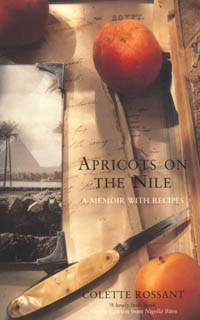
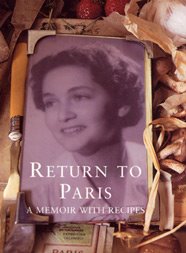
Speaking of culinary memoirs, my introduction to the genre were these two books by Colette Rossant. Ah! Cairo in the 1930's and Paris in the 1940's - it just doesn't get more exciting. But besides the story, which is fascinating I fell completely in love with these book covers. I think they are my all time favorites. The photographer is Jeff Cottenden and in his site you can see other book covers he has done as well as examples of his work. Beautiful - serene, melancholy and simultaneously tense, but in a comforting way.

Sunday, October 29, 2006


In the NY Times Books section you can read the first chapter of Madhur Jaffrey's memoir, Climbing the Mango Trees. I read it in the beginning of 2006 and found it wonderful, but I might be biased since I love women's memoirs with a culinary inclination. The hardcover edition has a beautiful cover and photographs inside.